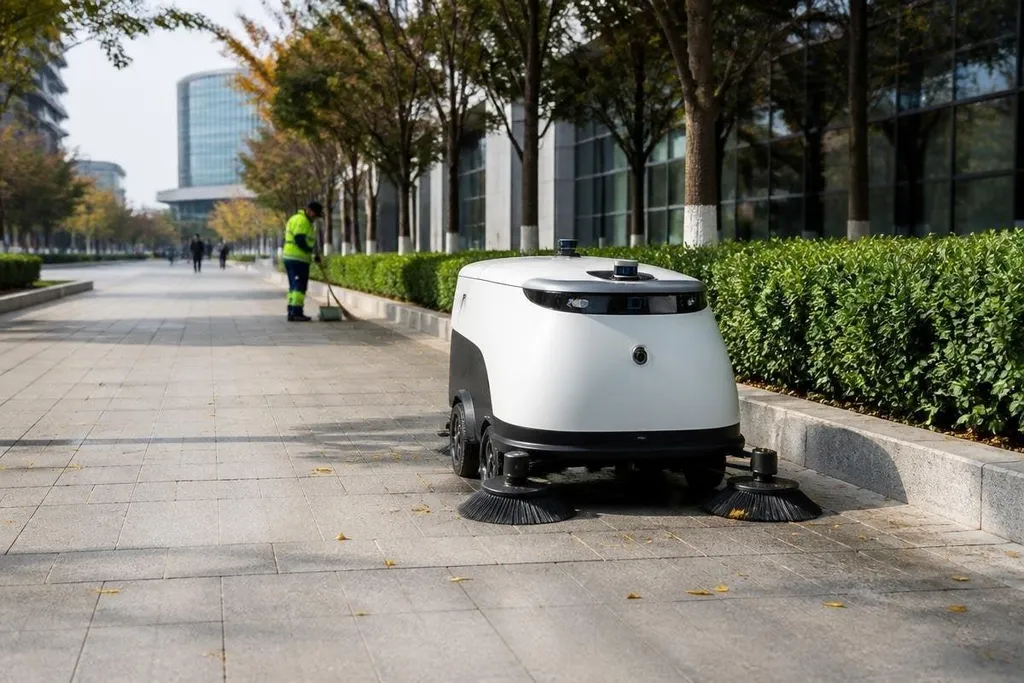
A city robot has to solve a paid problem before it becomes a viable business. The strongest openings sit in work that already costs money, happens on a set route, and can be measured without a debate over the results.
Quick read
- Waste collection robots could cut routine staff trips.
- Inspection robots can record the same site on a fixed schedule.
- Delivery robots need a clear service area, handoff point, and price per trip.
Start with work cities already buy
Public agencies already pay people to move goods, inspect assets, clean spaces, and collect information. A supplier can enter through those budgets instead of asking a city to invent a new service.
That distinction changes the sales pitch. The buyer needs to see the task, the current cost, the robot’s role, and the measure that decides if the contract works. “More automation” is too vague to price.
A small pilot might cover one route, one building, or one type of inspection. The contract should state the number of operating days, the staff time needed, the allowed failure rate, and who responds when the robot stops.
Five possible business models
The robot itself may not be the main product. A company can sell a service, rent the equipment, or charge for the data it collects.
Robot-as-a-service uses a monthly fee while the supplier handles repairs, software, and operator training. Task-based pricing charges per inspection, delivery, cleaned area, or completed route. An equipment sale sends the robot to the city, with maintenance, software updates, and spare parts priced separately.
Managed operations put the supplier in charge of the robots, with a remote operator sending the city a work report. A data service sells the images or measurements that support maintenance decisions.
Each model places a different burden on the supplier. A sale may bring money sooner, but a service contract can keep the supplier responsible for uptime and repairs.
A city buyer without a robotics team needs a clear plan for repairs after the pilot. Reports on city robots from Robot24.com can place the supplier, task, and service model beside the claim before the next section looks at where the work fits.
Where the work fits
Waste and street cleaning offer repeatable routes, but the robot must handle people, parked vehicles, weather, and changing road conditions. A narrow service zone may work better than a citywide promise.
Inspection work can be easier to define. For example, one robot might visit a tunnel, water facility, rail site, or public building and record the same points each time. The business case depends on whether those records help staff find damage sooner or plan repairs with less manual work.
Small delivery runs have a different limit. The robot needs a safe route, a secure handoff, and a person who can deal with blocked paths or an address problem. A service that works inside one hospital or campus may have a clearer path than open-city delivery.
Public safety work needs extra care. A robot that records video or identifies objects can raise privacy, data storage, and access questions before the first unit ships. Those rules belong in the contract, not in a later meeting.
What the buyer should measure
A city should ask for records from the pilot, not a promise about the finished fleet. The useful numbers are tied to the task: completed routes, stopped runs, staff hours, repair time, and cost per job.
The test also needs a human plan. Remote operation, emergency stops, charging, software updates, and public complaints all create work around the robot. If that work is missing from the price, the business case is incomplete.
I'd start with one paid route and a written exit rule. A supplier that can't state what counts as success has not defined the service yet.
A practical contract checklist
Before signing a pilot, check these points:
- Name the task: State the route, site, output, and operating hours.
- Set the measure: Record completed jobs, stops, staff time, and cost per job.
- Price support: Include charging, repairs, remote help, software, and training.
- Define data rights: State who owns images, maps, logs, and stored records.
- Plan failure: Set response times for faults, blocked routes, and safety events.
- Choose the exit: Set the date and score that decide whether the pilot ends or grows.
The first useful contract for a smart city robot will probably be small: one service, one area, and one number that decides if the work continues. That is where the business opportunity becomes measurable.